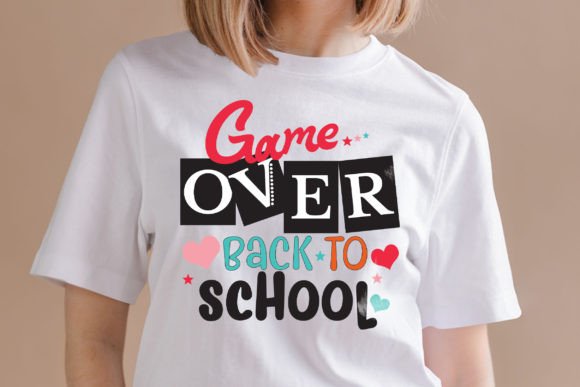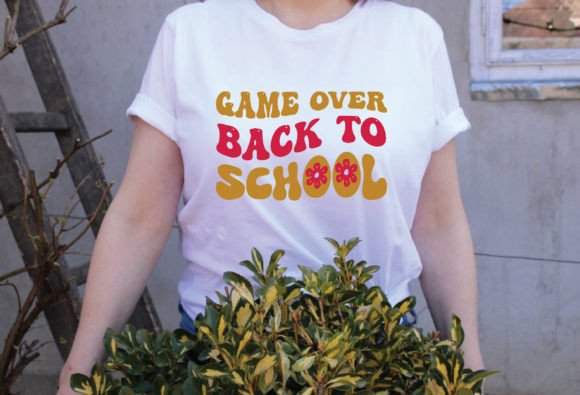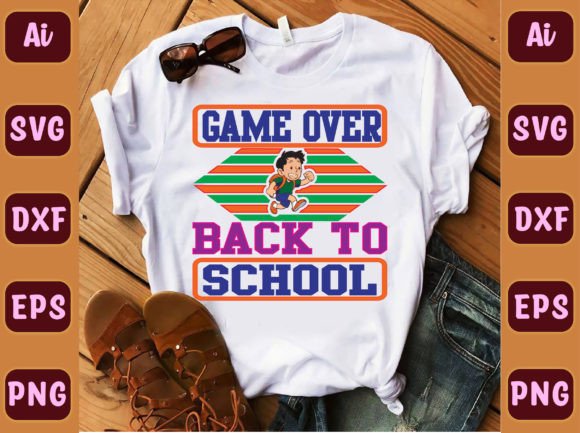
GAME over BACK to SCHOOL 21
If you've ever spent hours tweaking a design only to hit a wall with resolution loss, file compatibility, or color editing limits—you’ll recognize the quiet relief of finding a truly flexible, production-ready resource. GAME over BACK to SCHOOL 21 is more than a playful phrase on a graphic: it’s a fully editable, multi-format vector bundle built for real-world use—whether you're printing hoodies for a PTA fundraiser, prepping classroom posters, or launching a back-to-school merch line.
What exactly is GAME over BACK to SCHOOL 21?
It’s a cohesive digital design package centered around the bold, nostalgic, and slightly rebellious energy of “GAME over” reimagined for the new school year. Unlike static images or low-res downloads, this set ships in five industry-standard formats: SVG, DXF, EPS, PNG (300dpi, transparent background), and native Adobe Illustrator (.ai). Every shape is 100% vector-based—meaning it scales from a 1-inch sticker to a 48-inch banner without a single pixel blurring.
The design isn’t just resizable—it’s *reconfigurable*. Colors can be swapped in seconds inside Illustrator or Inkscape. Layers are organized and named. Text remains live-editable. And because it includes both vector and high-res raster options, you’re covered whether your workflow starts in Silhouette Studio, CorelDRAW, Cricut Design Space, or Photoshop.
Why does format variety matter—and who benefits most?
Not every creator uses the same tools—or faces the same constraints. What makes GAME over BACK to SCHOOL 21 practical isn’t just its visual style, but how thoughtfully its file types map to actual user needs.
- Beginners and hobbyists often start with free or low-cost software. The included DXF file opens natively in Silhouette Studio’s free version—no upgrade needed. The PNG gives instant drag-and-drop usability for Canva, Google Slides, or simple t-shirt mockups. No vector knowledge required.
- Educators and school staff value speed and clarity. A teacher designing a bulletin board or welcome slide can drop the transparent PNG straight into PowerPoint or Keynote. If they later want to adapt it for a vinyl-cut welcome sign, the SVG or DXF works seamlessly with classroom cutting machines.
- Freelancers and small business owners need reliability across client requests. One client may supply a Cricut; another, a local print shop that only accepts EPS or AI files. Having all five formats means no last-minute conversions, no quality compromises, and no awkward “Can you resend this as…” emails.
- Marketers and content creators care about consistency and brand alignment. The editable AI and EPS files let them match school colors, district fonts, or campaign palettes precisely—not approximate them. They can also extract individual elements (like the “21” or the “GAME over” text) to reuse across social graphics, email headers, or landing pages.
Quality isn’t just about resolution—it’s about intention
“300dpi” appears in many listings—but here, it’s meaningful because it applies *only where it matters*. The PNG is 300dpi *and* has a transparent background, so it drops cleanly onto any colored or textured surface—no white boxes, no cropping guesswork. Meanwhile, the vector files (SVG, EPS, AI, DXF) aren’t just exported copies—they’re built with clean anchor points, ungrouped layers, and minimal compound paths. That means less time untangling objects and more time customizing.
This attention shows up in subtle ways: the “O” in “GAME over” isn’t a stroke masquerading as a shape—it’s a true closed path, ready for fill adjustments or gradient mapping. The “21” isn’t flattened type—it’s outlined *but* retains logical layer grouping, so changing just the numbers (say, to “2025”) takes seconds, not minutes.
Real projects, real decisions
Imagine three different people evaluating GAME over BACK to SCHOOL 21 side by side:
- A PTA volunteer needs 50 vinyl stickers for student lockers by Friday. She uses Silhouette Studio. The DXF file imports instantly. She resizes to 2.5 inches, changes the red to navy (to match school colors), and sends it to cut—all in under 12 minutes.
- A graphic designer is building a suite of back-to-school assets for a regional education nonprofit. She opens the AI file, isolates the “BACK to SCHOOL” portion, replaces it with custom typography, and saves a new EPS for their print vendor—while keeping the original intact for future use.
- A student-run apparel club wants to sell limited-run tees. They upload the SVG to their print-on-demand dashboard, adjust contrast for screen printing, and run a test print. Because the vectors are crisp at any size, their small-batch order looks professional—not DIY.
None of these users needed the same thing. But each found what they needed—without workarounds, hidden fees, or compatibility surprises.
When might this *not* be the right fit?
That’s worth naming too. If you’re looking for a full design system—with matching fonts, icons, patterns, or alternate layouts—this is a strong standalone piece, not a toolkit. If you need animated versions, web-optimized SVGs with embedded CSS, or layered PSD files for photo compositing, those aren’t included. And while the design carries clear back-to-school energy, it’s intentionally stylized—not literal (no apples, pencils, or chalkboards). That’s a strength for some, a mismatch for others.
Final thoughts—practical next steps
You don’t need to be a vector expert to benefit from GAME over BACK to SCHOOL 21. You just need a project where clarity, scalability, and flexibility matter. Whether you’re prepping for August or planning ahead for next year, having one dependable, multi-format asset reduces friction—not just in execution, but in decision-making.
Before downloading: check which software you’ll actually use. If you mostly rely on Silhouette Studio, prioritize the DXF and SVG. If you’re handing files off to a printer, lean on EPS or AI. And if you’re sharing with teammates or clients who may not have design software, the PNG gives them immediate, reliable usage—no installation, no learning curve.
Thanks for downloading—and for making back to school look intentional, not improvised.