Game Overs Back to School Retro SVG: Strategic Design Assets for Intentional Branding and Communication
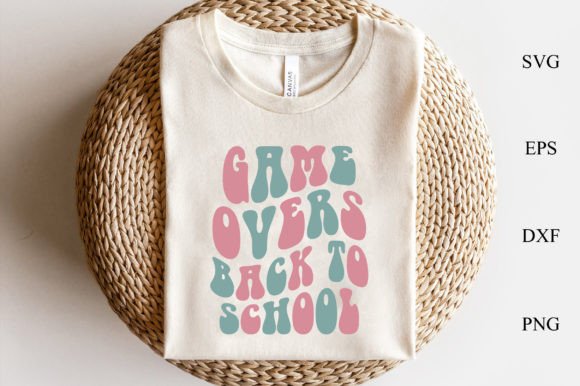
Game Overs Back to School Retro SVG isn’t just another nostalgic graphic—it’s a purpose-built design asset with measurable utility for professionals who prioritize clarity, consistency, and contextual resonance. Delivered in SVG, EPS, DXF, and PNG formats, this download offers technical flexibility without sacrificing creative control. Unlike generic clipart or overused templates, Game Overs Back to School Retro SVG carries intentional stylistic weight: bold outlines, limited palettes, pixel-inspired textures, and typographic nods to 8-bit and early console aesthetics. That specificity matters—not as decoration, but as a strategic signal.
Why Format Diversity Matters More Than You Think
Having Game Overs Back to School Retro SVG in multiple formats isn’t about redundancy—it’s about matching the right tool to the right outcome. SVG preserves scalability and editability for web interfaces, email headers, or interactive dashboards where crisp rendering at any size is non-negotiable. EPS supports high-resolution print workflows—think banners for school fairs, branded merchandise, or educator training materials. DXF enables precision cutting for vinyl decals, laser-etched signage, or physical classroom displays. PNG delivers immediate usability for social posts, slide decks, or digital newsletters where transparency and fast loading are priorities. Choosing one format over another reflects an intentional decision about audience, medium, and longevity—not convenience alone.
Strategic Use Cases Beyond Decoration
When deployed deliberately, Game Overs Back to School Retro SVG serves functional roles far beyond visual flair:
- Educators and curriculum designers use it to soften transitions between summer and structured learning—framing “back to school” not as a reset, but as a level-up moment. A retro game motif signals challenge, progression, and achievable goals—psychologically aligning with growth mindset principles.
- Small business owners launching fall promotions embed Game Overs Back to School Retro SVG into limited-time offers (e.g., “Level Up Your Skills” workshops or “Unlock 20% Off” campaigns), leveraging nostalgia to build emotional familiarity without sounding gimmicky.
- Freelancers and creators integrate it into client onboarding sequences—using the “Game Over” motif ironically (“Not game over—just version 2.0”) to reframe setbacks as iterative milestones. This subtly reinforces resilience and adaptability as core service values.
- Internal operations teams apply it in project dashboards to visualize sprint cycles: “Level 1: Research,” “Level 2: Draft,” “Boss Battle: Final Review.” The structure becomes instantly legible, reducing cognitive load during cross-functional alignment.
What Happens When You Use It Without Context?
Retro aesthetics carry implicit associations—playfulness, simplicity, analog warmth—but those associations only land when anchored to clear intent. Dropping Game Overs Back to School Retro SVG into a corporate compliance document or a financial forecast slide creates dissonance, not charm. Misalignment erodes credibility faster than outdated fonts. Worse, indiscriminate use dilutes its impact: if every team, campaign, or department deploys the same motif without variation in tone or application, it stops signifying anything distinct. It becomes wallpaper—not strategy.
How to Approach Integration Thoughtfully
Start with your objective—not the graphic. Ask: What action do I want the audience to take? What feeling should precede that action? What existing visual language does my brand already own? Game Overs Back to School Retro SVG works best when it extends, rather than contradicts, those foundations. For example:
- Map it to a specific phase of your workflow. If you’re rolling out a new LMS for faculty training, use the SVG only in the “onboarding kit” PDF—not across all internal comms. That containment gives it weight.
- Pair it with deliberate typography and color. Don’t rely on the SVG alone to carry meaning. Add concise microcopy (“Resume Progress,” “New Save Point”) in a clean sans-serif. Let the retro element evoke mood; let the words clarify function.
- Test contrast and hierarchy. In a busy slide or dense webpage layout, Game Overs Back to School Retro SVG can compete for attention. Reduce background noise, increase spacing, or adjust stroke weight to ensure it supports—not obscures—your message.
Long-Term Value Lies in Consistency, Not Frequency
Brands that sustain relevance rarely chase trends—they curate motifs with staying power. Game Overs Back to School Retro SVG has longevity because its core themes—progression, trial, recovery, and earned achievement—are timeless. But longevity requires restraint. Using it once per year for back-to-school initiatives builds recognition. Using it monthly across unrelated topics fragments perception. Think of it like a signature phrase: repeated meaningfully, it becomes part of your voice. Repeated randomly, it becomes white noise.
Decision-Making Guidance for Practical Adoption
Before integrating Game Overs Back to School Retro SVG, consider these three checkpoints:
- Is this supporting a defined goal—or filling space? If the answer leans toward the latter, pause. Even strong assets weaken when used without purpose.
- Does it align with how your audience currently perceives you? A law firm introducing retro gaming visuals mid-crisis communication risks misreading its own authority. But that same firm using it in a pro bono youth coding initiative? That’s coherence with intention.
- Can you maintain it? If you adopt Game Overs Back to School Retro SVG in marketing, ensure your design system includes documented usage rules—stroke weights, minimum sizes, acceptable backgrounds, prohibited combinations. Without guardrails, consistency collapses under pressure.
Realistic Planning Tips for Teams and Solo Practitioners
You don’t need a full design team to leverage Game Overs Back to School Retro SVG effectively. Start small and scale with evidence:
- Solo creators: Use the SVG in one recurring email series—e.g., your weekly “Progress Pulse” update—to visually reinforce forward motion. Track open rates and click-throughs for two months. Compare against prior versions without the motif.
- Small teams: Assign one person to audit current assets. Where are you already using playful or milestone-based language? That’s your natural integration point—not where you wish you were more “fun,” but where meaning already lives.
- Educators: Embed Game Overs Back to School Retro SVG into rubrics or self-assessment checklists—not as decoration, but as visual scaffolding. A “Level 3: Mastery” badge next to criteria makes progression tangible for students.
Final Strategic Observation
Game Overs Back to School Retro SVG succeeds not because it looks “cool,” but because it compresses complex ideas—effort, iteration, recovery, reward—into a single, widely understood visual shorthand. That compression saves time. It reduces ambiguity. It invites participation. But compression only helps when what’s being compressed is already meaningful to your audience. So before resizing, recoloring, or repositioning, ask: What am I trying to make easier to understand? What behavior am I trying to support? What story am I trying to keep consistent across touchpoints? Answer those first—and Game Overs Back to School Retro SVG becomes less of a download, and more of a decision-making tool.