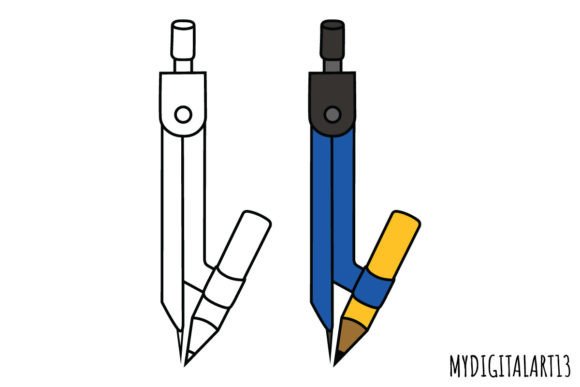
Compasses Clipart, Back to School
Whether you're designing classroom posters for the first day of school, crafting personalized student planners, or building a cohesive brand identity for an education-focused small business, Compasses Clipart, Back to School delivers immediate visual clarity and timeless symbolism. A compass doesn’t just point north—it represents direction, discovery, learning journeys, and intentional growth. That’s why this carefully crafted set stands out among generic school-themed graphics: it’s purpose-built for creators who value meaning *and* practicality.
Why These Compasses Work Where Others Fall Short
Many clipart packs sacrifice quality for quantity—blurry edges, inconsistent line weights, or awkward proportions that look amateurish when scaled or layered. Not these. Each compass in the Compasses Clipart, Back to School collection is hand-crafted at 300 DPI, ensuring crisp detail whether printed on letter-sized stationery or enlarged for a bulletin board banner. The transparent PNG format means no white boxes, no jagged halos, no time wasted erasing backgrounds in Photoshop. Drop them straight into Canva, Illustrator, Google Slides, or Microsoft Word—and they’ll sit cleanly over photos, gradients, or textured paper.
You’ll receive two versions per design: one vibrant color image with thoughtful shading and subtle metallic accents (ideal for invitations or digital newsletters), and one clean black-and-white version (perfect for handouts, stencils, embroidery guides, or monochrome branding). This dual-format approach saves hours—no need to convert, desaturate, or manually trace outlines.
Real-World Uses You’ll Reach For Again and Again
This isn’t clipart you download once and forget. It’s a working tool—one that adapts across contexts without losing impact.
- Educators: Use the black-and-white compass to create guided note-taking templates for geography units—or layer the color version over a “Growth Mindset” poster to visually reinforce goal-setting and self-direction.
- Small Business Owners: If you sell custom planners, academic coaching services, or STEM kits for kids, this compass adds instant credibility. Place it subtly in your logo watermark, on invoice headers, or as a recurring motif in email footers—it signals structure, guidance, and trustworthiness.
- Scrapbookers & Paper Crafters: Print the PNGs on sticker paper, cut them with precision dies, or use them as focal points on handmade greeting cards for graduation, teacher appreciation, or orientation week. Because the edges are truly transparent, shadows and drop effects render naturally in design software.
- Bloggers & Content Creators: Pair the compass with short captions like “Finding Your Focus This Semester” or “Where Learning Takes You”—then embed directly into blog posts or Pinterest pins. Its symbolic resonance boosts engagement more than decorative icons ever could.
- Freelance Designers: When clients ask for “school-ready but not childish” assets, this set hits the sweet spot. It avoids cartoonish clichés (no smiling apples or oversized pencils) while still feeling warm, approachable, and academically grounded.
What Makes These Compasses Feel Thoughtful—Not Just Pretty
Look closely: the needle isn’t just centered—it’s angled slightly, suggesting motion and intention. The housing includes fine engraved lines and balanced weight distribution, giving it presence without clutter. There’s no unnecessary ornamentation, yet it never reads as sterile or clinical. That balance matters. In educational materials, visuals must support—not distract from—learning. In branding, they must reflect values without shouting them. These compasses do both.
They’re also scalable without compromise. Enlarge to 300% for a large-format wall decal? Still razor-sharp. Shrink to 12pt for a subtle watermark in a PDF syllabus? Still legible and elegant. That reliability reduces revision rounds, eliminates last-minute asset swaps, and keeps your workflow moving.
Smart Implementation Tips—From Experience
If you’re integrating Compasses Clipart, Back to School into ongoing projects, keep these practical notes in mind:
- Consistency builds recognition. Pick one version—the color or the B&W—and use it uniformly across related materials (e.g., all planner inserts, or every slide in a faculty training deck). Repeating the same compass style reinforces visual cohesion far more than rotating between multiple clipart sets.
- Respect contrast and context. The color compass works best against light or neutral backgrounds. For dark-mode websites or navy-themed presentations, switch to the black-and-white version—it maintains readability where saturated colors might wash out.
- Layer intentionally. Try placing text *over* the compass dial—not just beside it. Use a semi-transparent overlay or light stroke on your headline to ensure legibility. This creates depth and draws the eye to your message while keeping the symbol prominent.
- Don’t overuse symbolism. One well-placed compass carries more weight than three scattered randomly. Let it anchor key moments: the cover of a course guide, the header of a scholarship application page, or the closing graphic of a student orientation video.
More Than Decoration—A Practical Asset for Meaningful Work
At its core, Compasses Clipart, Back to School answers a quiet but persistent need: the desire for visuals that feel authentic to learning, growth, and guidance—without leaning on tired tropes or sacrificing technical polish. It’s designed by someone who’s stood in front of a classroom, managed a creative studio, and built digital products for educators. That lived experience shows in the details: the spacing around the needle, the transparency fidelity, the intentional restraint in color and line.
For professionals juggling tight deadlines and high expectations, these compasses aren’t just another download—they’re a time-saver, a tone-setter, and a subtle way to align your materials with what truly matters in education and personal development: clarity, curiosity, and forward movement.
Whether you’re prepping for September or planning year-round resources, this set earns its place in your toolkit—not because it’s trendy, but because it works, consistently, across media, audiences, and intentions.