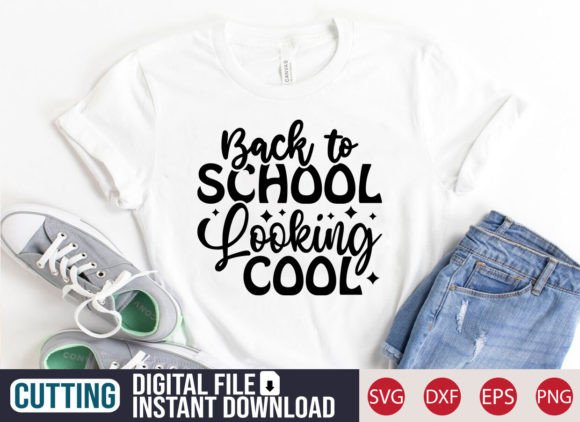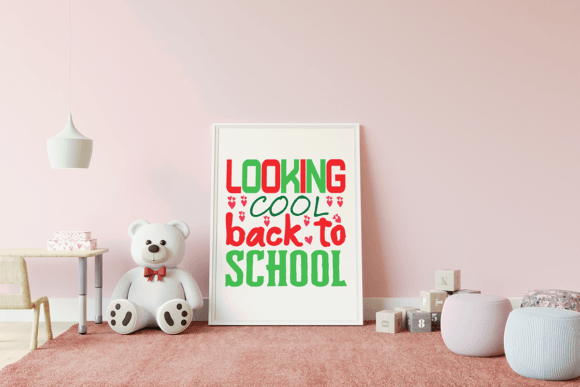
Looking Cool Back to School Design: A Practical Guide for Creators and Educators
A Looking Cool Back to School Design is more than a seasonal graphic—it’s a versatile, production-ready vector resource tailored for adults who create custom school-related materials. Whether you're designing spirit wear for a PTA fundraiser, prepping classroom decor, or launching a small business selling personalized student gear, this design offers a balance of aesthetic appeal and technical flexibility. Unlike generic clipart or raster-based school-themed images, the Looking Cool Back to School Design is built from 100% vector shapes, meaning it scales infinitely without pixelation and adapts cleanly across physical and digital applications.
What Makes This Design Distinctive?
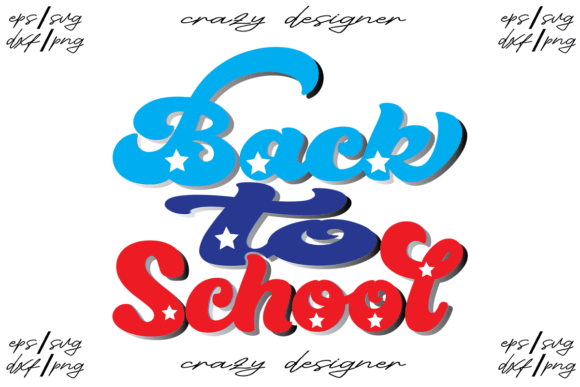
The core distinction lies in its file ecosystem and intentional construction. Each Looking Cool Back to School Design includes SVG, DXF, EPS, and transparent PNG formats—each serving a specific workflow need. SVG files integrate seamlessly with web tools and Cricut Design Space; DXF supports Silhouette Studio and other precision cutters; EPS ensures compatibility with professional-grade plotters like Roland and Mimaki; and the high-resolution PNG provides immediate use as scalable clipart or digital overlays. Crucially, all vector layers are fully editable: colors can be adjusted in seconds using any vector editor, and individual elements (e.g., backpacks, pencils, graduation caps) can be isolated, resized, or recolored without affecting integrity.
This isn’t a static image repurposed across formats—it’s a unified asset system designed around real-world production constraints. For example, if you’re printing iron-on transfers for teacher appreciation shirts, the EPS version retains crisp paths for heat-press vinyl cutting. If you’re making printable classroom banners, the SVG scales flawlessly to 36" wide without rendering artifacts. That level of fidelity across contexts is rare in mass-market school graphics.
How It Compares to Other School-Themed Resources
Many users start with free online clipart libraries or subscription-based design platforms. While those offer volume and convenience, they often lack production readiness. Free PNG downloads typically arrive at fixed resolutions (e.g., 1500×1500 px), limiting large-format printing. Subscription services may restrict commercial use or embed watermarks unless upgraded—adding cost and complexity when scaling output.
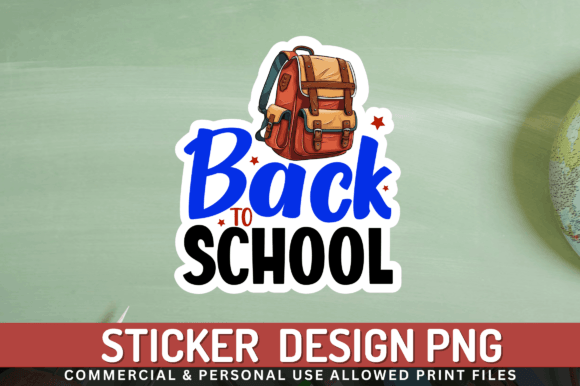
In contrast, a standalone Looking Cool Back to School Design grants perpetual, royalty-free usage rights for both personal and commercial projects—including apparel, stickers, mugs, and invitations—as long as the files remain unaltered in their original distributed form. There’s no recurring fee, no login dependency, and no platform lock-in. You own the files outright, which matters if you’re managing multiple school-year campaigns or building a consistent brand identity across years.
That said, it’s not universally optimal. If your need is strictly digital—say, adding a fun icon to a Google Slides presentation—a lightweight SVG from a free library may suffice. Or if you require dozens of coordinated designs (e.g., subject-specific icons for math, science, art), a curated bundle might offer broader stylistic consistency than a single design. The Looking Cool Back to School Design excels when you prioritize adaptability over quantity, and control over convenience.
Real-World Use Cases and Practical Tradeoffs
Consider three common scenarios:
- Small-Batch Apparel Printing: You’re screen-printing 25 t-shirts for a middle school orientation team. With the EPS and SVG versions, you can adjust color palettes to match school colors, convert outlines for vinyl weeding, and export clean separations for spot-color printing—all within one file set. No need to rebuild artwork in Illustrator from scratch.
- Classroom Decoration Kits: You’re assembling printable welcome posters, name tags, and bulletin board accents. The transparent PNG works instantly in Canva or PowerPoint, while the SVG allows precise resizing for laminated door signs or window decals. Because the design uses vector shapes—not embedded raster effects—you avoid blurry edges when enlarging.
- Craft-Based Projects: You run a local craft fair booth selling custom iron-ons and enamel pins. The DXF and EPS files import cleanly into Glowforge, Cricut, or laser engraving software. You can nest multiple sizes on one material sheet, adjust kerf compensation, and maintain sharp corners—something raster-based alternatives struggle with at small scales.
The tradeoff? This design assumes basic familiarity with vector editing tools. Someone entirely new to Inkscape or Adobe Illustrator may need 20–30 minutes to learn how to change a fill color or export a PNG at custom dimensions. It’s not “click-and-print” in the way some drag-and-drop apps promise—but that learning curve pays off in long-term flexibility and quality control.
When It’s the Right Choice—and When It Might Not Be
A Looking Cool Back to School Design fits best when your goals involve customization, scalability, and multi-platform reuse. It’s especially valuable if you:
- Produce physical goods (vinyl decals, embroidered patches, engraved wood signs);
- Need consistent branding across print and digital touchpoints;
- Work with varying output sizes—from 2" stickers to 48" wall decals;
- Prefer owning assets outright rather than relying on cloud-based subscriptions;
- Value time saved in manual tracing or redrawing low-res graphics.
Conversely, it may be over-engineered if your needs are narrow and temporary—for instance, sourcing a single social media banner for a school newsletter, where a well-sized JPEG from a trusted education blog would serve equally well. Likewise, educators with limited access to design software or tight turnaround windows may find simpler, pre-formatted templates more practical—even if they sacrifice some flexibility.
Technical Considerations Beyond Format Lists
Not all vector files are created equal. Some “EPS” files are merely exported raster images wrapped in an EPS container—rendering them useless for cutting machines. A true Looking Cool Back to School Design uses native vector paths (not traced bitmaps), maintains clean anchor points, and avoids unsupported effects like gradients or transparency blends that break in older cutters. The inclusion of DXF—a format known for reliability in CNC and vinyl workflows—signals deliberate engineering for hardware compatibility.
Also worth noting: the transparent PNG isn’t just a fallback. At 300 DPI and layered with alpha transparency, it supports advanced compositing in photo editors and video tools—useful for creating animated back-to-school social posts or hybrid print-digital kits. That dual-purpose utility separates it from lower-fidelity alternatives.
Making an Informed Decision
Before choosing any school-themed design resource, ask three questions:
- Where will this be used? If output spans t-shirts, stickers, cards, and digital slides, vector versatility becomes essential—not optional.
- Who controls the final output? If you rely on third-party printers or vendors, confirm whether they require specific formats (e.g., EPS for screen printing, DXF for laser cutting). A comprehensive file package reduces back-and-forth.
- How much future adaptation do you anticipate? Will next year’s version need updated fonts, new icons, or alternate color schemes? Editable vectors let you iterate without repurchasing.
A Looking Cool Back to School Design answers all three affirmatively. It doesn’t replace thoughtful design judgment—but it removes technical friction so you can focus on purpose, audience, and impact. Whether you're equipping a classroom, supporting a student group, or growing a creative side hustle, having a reliable, adaptable foundation makes the difference between reactive problem-solving and intentional creation.